India · 2021 · One of the three winning entries, international competition
National Unity Pavilion
Notions of India
Architecture that fosters democracy
The National Unity Pavilion is Collaborative Architecture’s winning proposal for Notions of India, an international competition organized by Tata Steel to commemorate 75 years of Indian independence. Selected as one of three winning entries from 575 submissions, the project asks a fundamental question: can architecture give spatial form to the idea of a nation shaped by multiple histories, cultures, beliefs, and languages?
The pavilion forms part of Collaborative Architecture’s broader inquiry into Architecture That Fosters Democracy—a body of speculative architectural work exploring how space can enable deliberation, plurality, civic participation, and non-violence. Alongside the studio’s Peace Pavilion, conceived for a national war memorial competition, it investigates architecture not simply as a representation of collective ideals, but as a framework within which those ideals can be encountered, negotiated, and contested.
Rather than reducing India to a singular architectural symbol, the National Unity Pavilion constructs its identity through overlapping cultural, philosophical, and democratic references. It interprets the nation as a living palimpsest: an evolving collective consciousness grounded in historical memory, constitutional values, and the ideal of unity in diversity. In doing so, the project considers democracy not as a settled condition or an aspiration to uniformity, but as an ongoing negotiation between difference and belonging.
- Location
- India
- Organizer
- Tata Steel
- Typology
- Pavilion, Civic
- Status
- One of the three winning entries, international competition
- Year
- 2021
- Structure
- Web Structures | Ramboll
- Video
- Awards
- Notions of India 2021
The approach across the water · Click any image to open the viewer
Democracy as the coexistence of difference
Situated within India’s heterogeneous social and cultural fabric, the pavilion explores how architecture might accommodate divergent identities within a shared civic framework. Its conceptual foundations draw on the philosophical lineage of the Buddha, Ashoka, and Gandhi, bringing traditions of non-violence and ethical coexistence into dialogue with the democratic principles of the Constitution. Federalism, pluralism, and the freedom to differ inform an architectural proposition that resists a single, authoritative interpretation of nationhood.
The project does not seek to resolve India’s cultural complexity into a unified visual language. Instead, it gives form to the relationship between distinct parts and a collective whole. The pavilion becomes a setting in which visitors can encounter the idea of India as a continuing civic project—one shaped by its many communities, histories, contradictions, and aspirations. Unity is understood not as the absence of difference, but as the capacity to sustain difference through shared principles and mutual recognition.
A stupa, a mandala, and a civic landscape
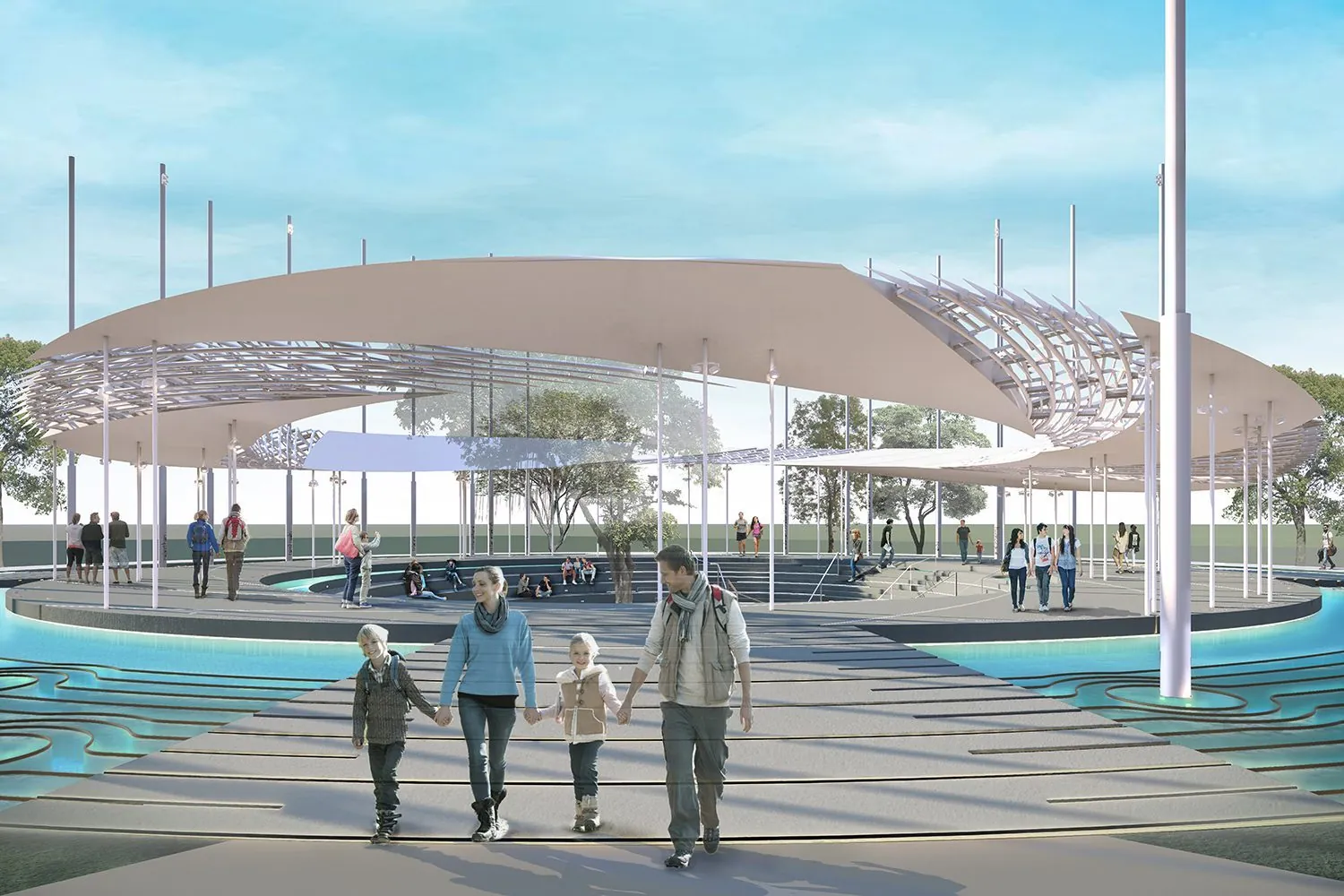
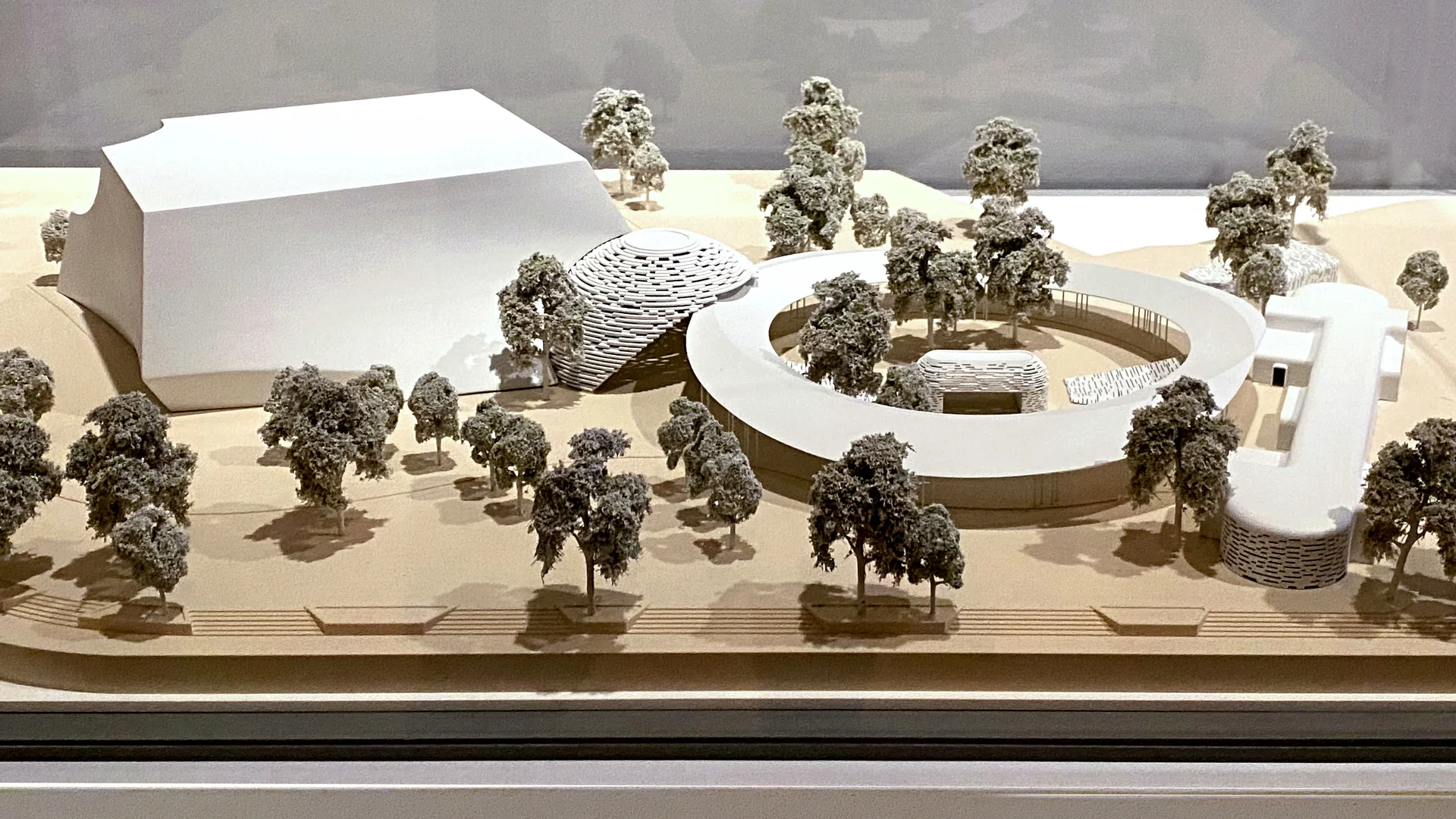
The pavilion’s overall diameter and volume draw from the Great Stupa at Sanchi, translating the scale and symbolic resonance of an ancient architectural form into a contemporary civic setting. Its geometry is organized through overlapping mandalas, establishing the spatial order and sequence of the pavilion. A circular route guides visitors through the experience, evoking the Dharma Chakra and its resonances across India’s major religious and philosophical traditions.
Encircling the pavilion, a series of pylons represents India’s states and union territories. Set within a reflecting pool, they establish a collective perimeter around the central space while expressing the relationship between regional identities and the larger union. Each pylon also serves as an entry point into a wider cultural narrative, connected to a QR-coded disc embedded in the circular gallery floor. Through digital interfaces, visitors can access additional media, extending the physical experience into a broader exploration of India’s regional and cultural plurality.
At the center of the composition, an amphitheater gathers around a Bodhi tree, conceived as the genius loci—the spirit and living center of the place. The tree anchors a shared civic space for encounter, dialogue, and collective reflection. Here, visitors can exchange ideas, deliberate differences, and participate in a common setting without the expectation of uniformity. The architecture brings together the philosophical resonance of an ancient landscape and the contemporary democratic imperative to make room for discussion, critique, and solidarity.
From national symbol to democratic practice
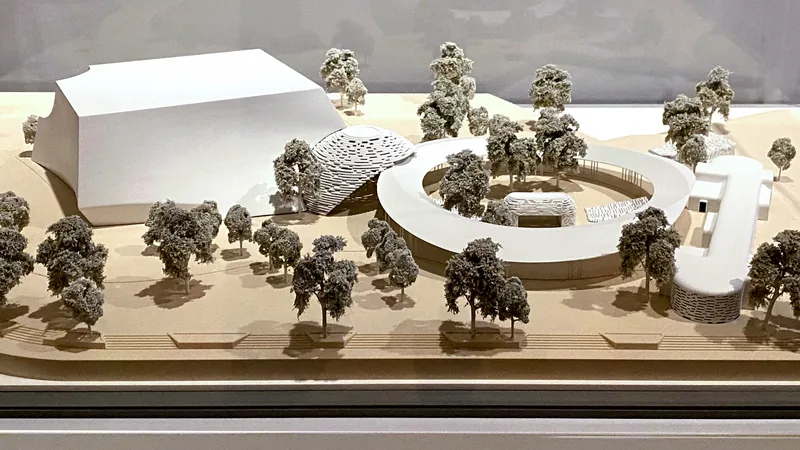
The National Unity Pavilion extends Collaborative Architecture’s exploration of the relationship between architecture and democratic life. Its companion project, the Peace Pavilion, approaches this question through a different institutional and spatial premise: conceived at the entrance to a national war museum, it repositions peace as the primary curatorial narrative, transforming the threshold into a public plaza and contemplative forum. Where the Peace Pavilion questions the conventional glorification of conflict, the National Unity Pavilion examines the conditions through which a plural society might recognize and sustain its collective identity.
Together, these projects form part of a continuing investigation into Architecture That Fosters Democracy. They draw on culturally embedded spatial practices and historical allegories rather than reproducing established democratic archetypes. Their ambition is to create settings for public encounter in which plurality, deliberation, and non-violence become spatial and social propositions.
Yet the projects also acknowledge the limits of architecture’s agency. A pavilion cannot, by itself, secure democratic participation or resolve political and cultural differences. Its role is more provisional and critical: to establish conditions in which people can gather, reflect, disagree, and imagine forms of coexistence. The National Unity Pavilion therefore moves beyond the representation of national identity to consider architecture as a medium through which the possibilities—and contradictions—of democracy can be experienced and continually renegotiated.
In numbers and honors
Drawings and process
Awards and Press
- Design
- Principals | Lalita Tharani, Mujib AhmedProject team | Anjum Ansari
- Images
- Ujjwal Sawant
Related projects · More projects in India →
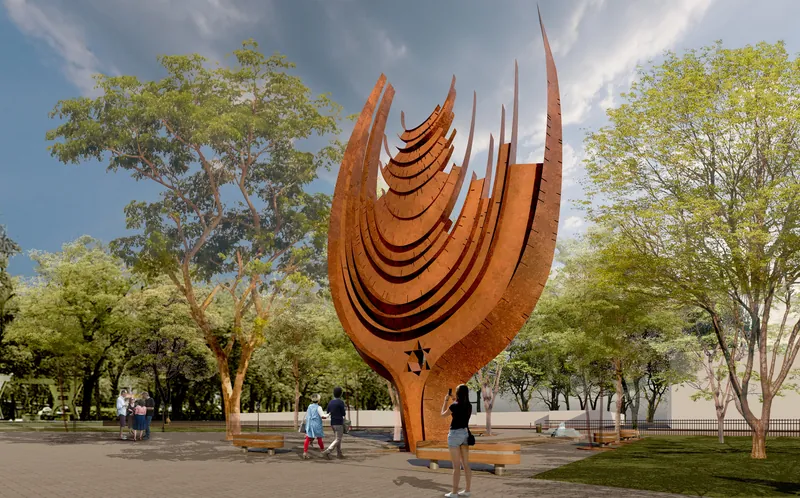
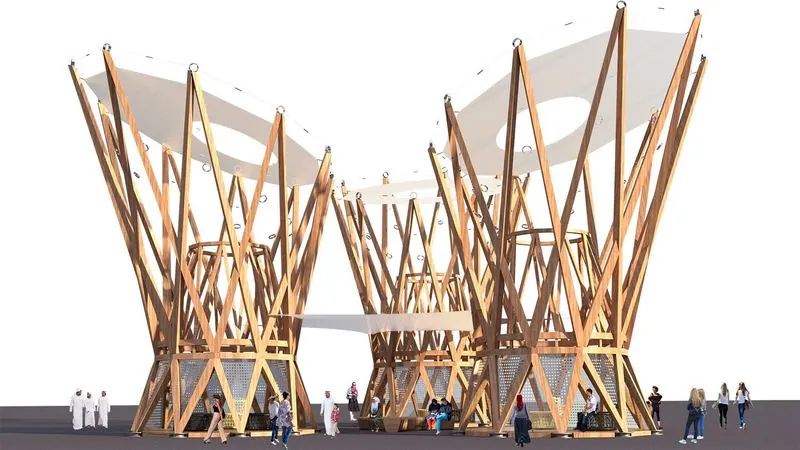
Peace Pavilion
Indian National War (Peace) Museum, New Delhi